Practise the conversation, not just the phrase: speaking Kiswahili
Practise spoken Kiswahili with role-play and an AI tutor, instead of only memorising phrases. How Convoria structures a conversation-first lesson.
You've learnt Habari yako? You can say Ninatoka Nairobi without looking at the list. Then somebody actually answers you, quickly, with a greeting that isn't the one in the book, and asks you something back. And you freeze, and the conversation has moved on before you've found your first word.
That gap is what we built Convoria around. You still learn the words and the rules, but you also get to practise the conversation itself, the bit that happens after the first line.
Convoria is a language app from Beacon Creek. You can use it on the web or install the free Android APK. There is no live Google Play or App Store listing today. New accounts get 30 days free, with no card needed. This post is about speaking, with Kiswahili running through it. We're not promising you'll be fluent in some number of days, and an app isn't a replacement for a teacher or an examiner.
Real conversation is mostly the next turn: answering a follow-up, asking someone to say it again, or getting from the greeting to an actual question.
Key takeaways
- Hold-to-talk tutor calls, role-plays and pronunciation scores are practice feedback, not an official exam result. Like any AI tutor, it can be wrong, and it needs a connection.
- Take the placement test if you already know some of the language, so you are not sent back to lesson one.
- Convoria has twelve courses, described as running up to C2 on the CEFR scale. Zulu and Kinyarwanda are still under native-speaker review.
- Narration and saved units can be used without data. AI tutors need a connection. See How to learn a language on a matatu.
- Use the web app or the free Android APK.
Why doesn't the phrase list get me there?
Because real conversation is mostly the next turn. Answering a follow-up, asking someone to say it again, getting from the greeting to an actual question. A useful first sentence — Habari yako? or Ninatoka Nairobi — is a good start. It is not the whole skill.
On our product page you'll see hold-to-talk voice calls with an AI tutor, role-plays, and fluency and accuracy scores. You can role-play somewhere like a market stall, a job interview or an airport queue, and get scored corrections afterwards. There's also word-by-word pronunciation scoring and a shadowing studio. The tutor needs a connection.
Take those scores as practice feedback, though, not an official exam result. And like any AI tutor, it can get things wrong.
What does a speaking session look like?
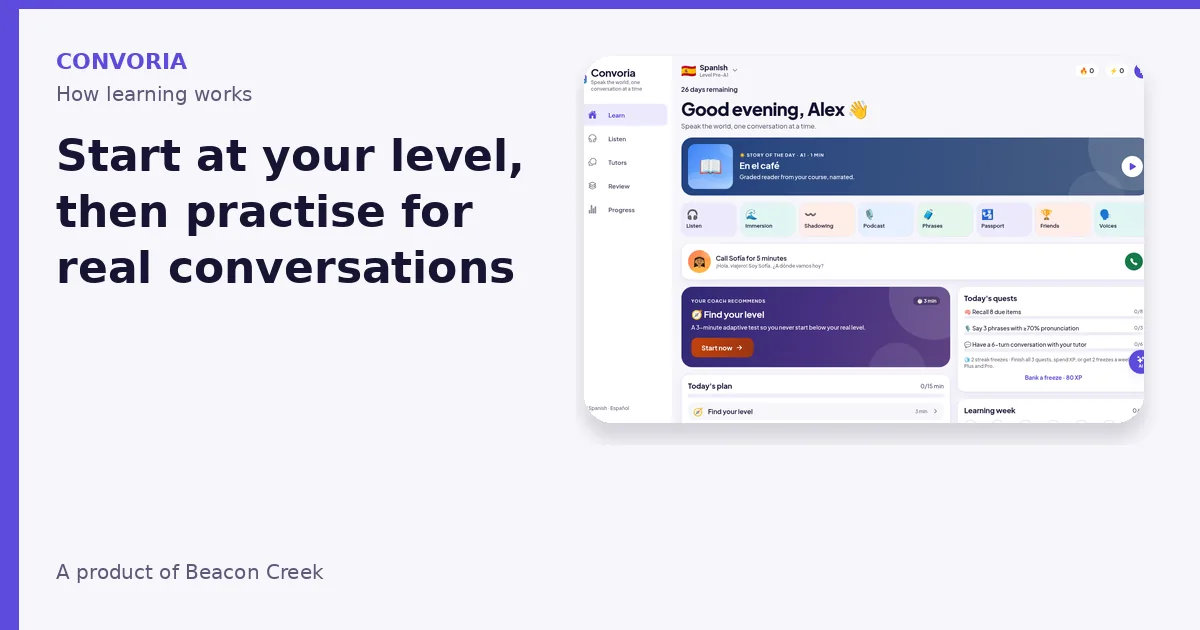
Here's roughly how it goes, as also outlined in How learning works in Convoria:
- Open Convoria, or install the Android APK, and the free month starts when you sign up. No card is required.
- If you already know some Kiswahili, take the placement test so you aren't sent back to lesson one. If you'd rather start as a complete beginner, you can skip it.
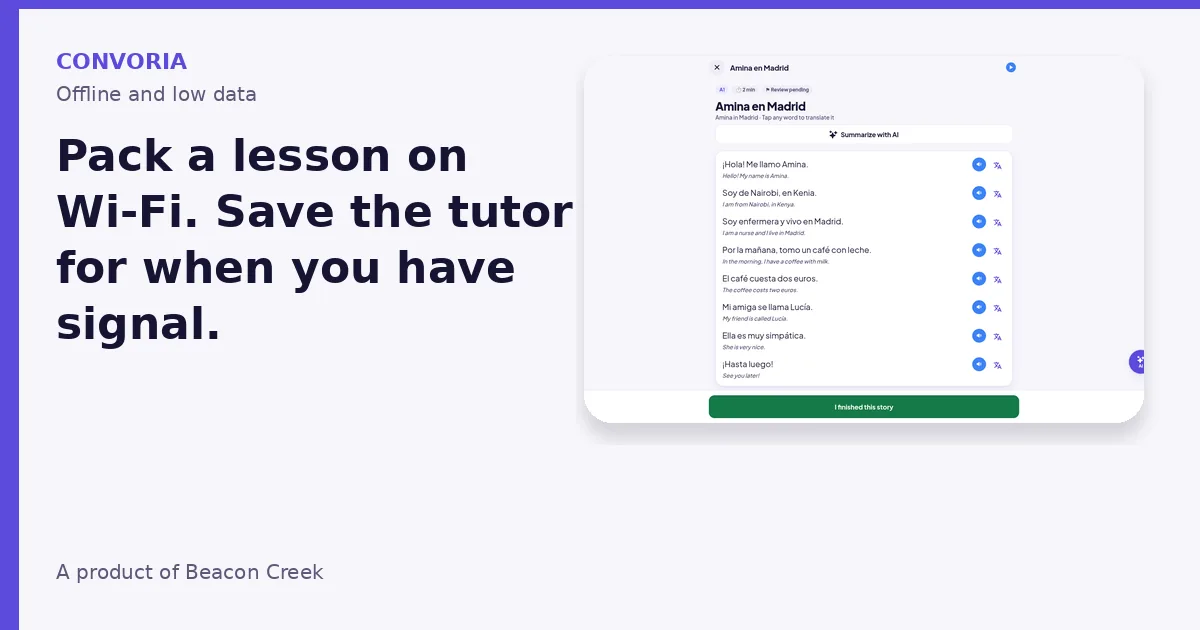
- Then you're into bite-size lessons, with narrated dialogues, new words and short exercises. The graded stories have narration and a translation for each line, and you can tap any word to translate it and save it for later.
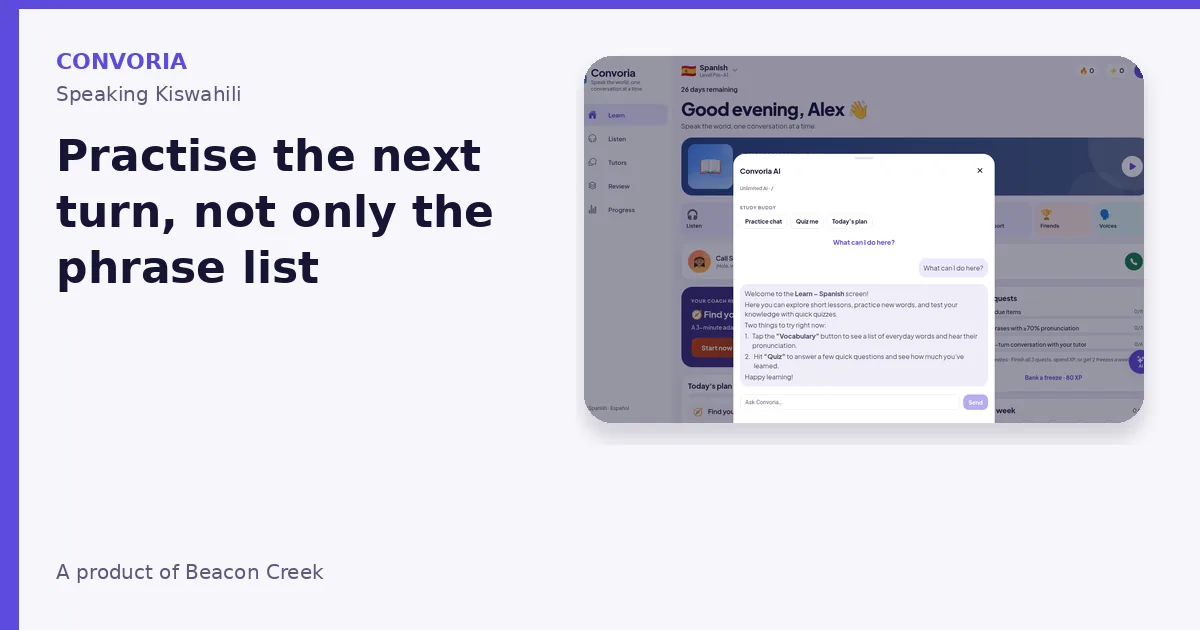
- Now the speaking part. You hold to talk with the AI tutor, and it answers out loud with captions on screen. Or you step into a role-play and look over your scores when it's done. The tutor needs a connection.
- After that, reviews bring the words back before you forget them. The product uses spaced reviews (FSRS) for this.
Stuck on something? Stuck? Ask AI gives you a hint first, then explains the answer. Use it like a coach, then go back and say the line out loud yourself.
Is Kiswahili one of the main languages?
It is. Convoria lists twelve languages, each described as running up to C2 (Mastery) on the CEFR scale. They are English, Kiswahili, French, German, Spanish, Arabic, Japanese, Korean, Mandarin, Italian, Zulu and Kinyarwanda, and the explanations can show up in your own language. Zulu and Kinyarwanda are still under native-speaker review. If you pick one of those two, treat the material as under review, not finished.

Kiswahili is a national language of Kenya and is used widely across East Africa. We're not going to throw speaker numbers at you. If you want to read about its official status, the legal texts are public on Kenya Law, which is a better source than a product blog. Kiswahili is also taught in Kenyan schools; the Kenya Institute of Curriculum Development publishes the official curriculum materials. What we can offer is a course you can actually speak into, Kiswahili included, with a placement test so "for beginners" is something you choose, not where you're dumped.
Maybe you grew up hearing Kiswahili at home and want to tidy it up for work. Maybe you're coming in from English. Either way, don't guess your level, take the placement test. The result is just where you start. It isn't a public grade, and you can still test out of a unit later if it's too easy.
A mid-lesson pause
Open Convoria and start the free 30 days when you're ready, no card needed. You can also download the Android APK.
New accounts get a free month of Convoria. No card is needed.
What it isn't
You won't get an official language certificate from a government body. The app can issue practice certificates and a shareable Proficiency Passport; those are records of practice, not a government certificate. It isn't a marketplace for language exchange with real people either. There are friends, leagues and a leaderboard, with block and report controls, but none of that stands in for chatting with someone in a shop or an office.
And it's not only for Kiswahili. If what you really want is spoken English, or another of the twelve courses, the same role-play and tutor tools work for that.
A small habit that's easy to keep
You don't need a whole evening. A short session, done regularly, is what stops the next turn feeling brand new every time.
- Do one lesson or story, out loud rather than just tapping through.
- Add one role-play or a short tutor call about a situation you'll really be in, maybe the market, a meeting or the queue at the airport. The tutor needs a connection.
- Then clear the words that are due for review instead of starting another new list.
If most of your practice happens on a matatu or on a thin data bundle, have a look at How to learn a language on a matatu.
And if a child shares your phone, kids mode has a parent PIN and a daily time limit. It is available during the free month and on the Family plan. That's a product control, not a childcare claim. For the official rules on personal data in Kenya, including children's data, see the Office of the Data Protection Commissioner.
FAQ
Do I get an official certificate at the end?
No. The scores, certificates and Proficiency Passport in the app are records of your practice, not a government certificate.
Can I use the AI tutor offline?
No, the AI tutors need a connection. Pack your lessons, stories and narration for the commute and keep the tutor calls for when you've got signal.
Is Kiswahili really one of the twelve?
Yes. The full list is English, Kiswahili, French, German, Spanish, Arabic, Japanese, Korean, Mandarin, Italian, Zulu and Kinyarwanda, with Zulu and Kinyarwanda still under native-speaker review.
Do I have to start from lesson one?
Only if you want to. Take the placement test, or skip it and start as a beginner.
Try it
Open Convoria, or install the Android APK, and start the free 30-day period when you are ready. No card is required.
New accounts get a free month of Convoria. No card is needed.

Beacon Creek Team